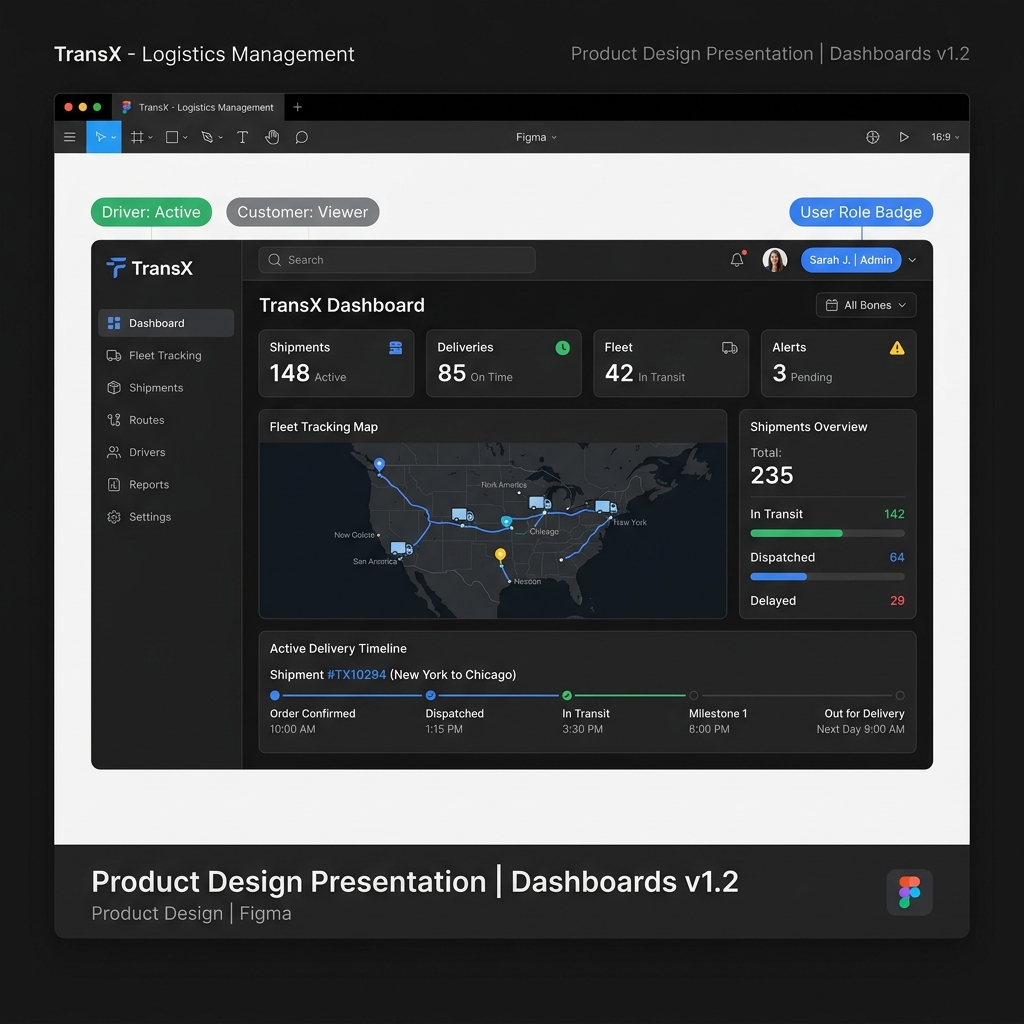
Logistics companies face high costs and delivery delays due to communication silos between dispatchers, drivers, and end customers during delivery exceptions.
A unified multi-role logistics management platform providing real-time fleet telemetry, automated exception handling, and instant digital Proof-of-Delivery.
Designed a multi-role system architecture covering Admin, Driver, and Customer touchpoints with exception handling protocols.
Project Overview & Context
TransX orchestrates freight operations by bridging communication gaps across dispatchers, truck drivers, and clients across the entire shipment lifecycle.
Domain workflow mapping, multi-role information architecture, enterprise dashboard layout, driver mobile UX, and edge-case exception flows.
The Problem & Core Friction
Logistics dispatchers, fleet managers, truck drivers, and enterprise recipients.
Delivery exceptions (road delays, missing customs documents, parcel damage) trigger chaotic manual phone calls and uncoordinated status updates.
Legacy systems operate in isolated silos where drivers cannot upload real-time evidence and dispatchers lack visibility into live route conditions.
Leads to operational downtime, customer dissatisfaction, delayed invoicing, and high overhead costs.
Research Methodology & Discovery
Map the end-to-end shipment lifecycle across 3 key roles and identify delay triggers during freight transit.
Logistics domain research, competitive system benchmarks, and workflow analysis.
Secondary industry benchmarks & 4 domain expert interviews.
Primary research was conducted with domestic freight dispatchers; international maritime shipping was kept out of scope.
How do dispatchers handle unexpected route detours or vehicle breakdowns?
What documentation is required by drivers at delivery check-in?
How do enterprise customers track high-value freight in transit?
Evidence Synthesis & Key Findings
01. Information Silos During Detours
Dispatchers relied on periodic phone calls to check driver locations, causing delayed customer updates.
Implement real-time GPS fleet telemetry and automated delay notifications.
02. Document Processing Delays
Physical paper Proof-of-Delivery (PoD) forms took up to 5 days to reach accounting.
Build instant camera-based PoD upload with offline sync on the driver app.
03. Unhandled Delivery Exceptions
Damaged packages resulted in long disputes because evidence was not captured at handover.
Introduce a mandatory guided Exception Protocol step when marking a delivery as flagged.
User Flow & Decision Architecture
End-to-end shipment lifecycle from dispatch creation to customer delivery handover.
Dispatcher Admin Portal -> Driver Mobile App -> Customer Live Tracking Link.
Digital PoD signed + automated invoice trigger.
Design Decisions & Interface Solutions
Multi-Role Dashboard Architecture
Admin dispatchers need macro fleet status while drivers need minimal, high-contrast action items.
Created tailored interfaces: high-density desktop tables for Admins, simplified large-target cards for Drivers.
Automated Exception Recovery Matrix
When deliveries fail, teams lacked standardized recovery steps.
Designed dynamic exception protocols (e.g. damaged parcel triggers photo evidence upload and instant replacement ticket creation).
Usability Validation & Iteration
3 logistics operations managers
In simulated workflow walkthroughs with 3 operations managers, participants completed shipment creation tasks without navigation blockers. Concept project with no live fleet telemetry.
Dispatchers needed to filter active shipments by delay severity rather than chronologically.
Added a prominent 'Severity Alert' filter to the live fleet tracking map view.
Outcome, Learnings & Next Steps
TransX established a design framework for multi-role logistics operations. As a concept project, validation was conducted via domain walkthroughs with 3 operations managers rather than live fleet data.
Systems thinking requires balancing the distinct operational needs of desk dispatchers and mobile field drivers.
Extend system capabilities for automated route optimization algorithms.